

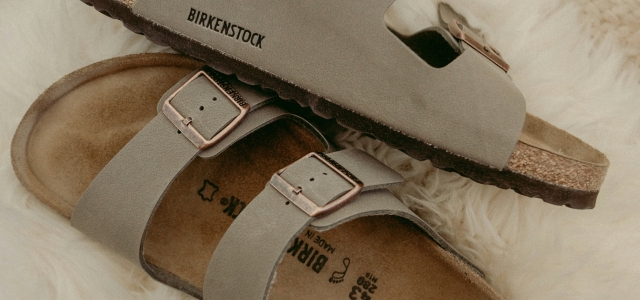
The District Court of Gelderland has ordered Lidl to stop selling five sandal designs found to infringe copyright in specific elements of Birkenstock’s footwear.
The District Court of Gelderland, sitting in Arnhem, has ordered Lidl to stop selling lookalike versions of Birkenstock’s Arizona, Madrid, Gizeh, Boston, and Florida sandals in the Netherlands.
The September 23 judgment found that Lidl’s sandals infringed copyright in specific elements of Birkenstock’s designs. The court found that one element of the lower part of the Birkenstock sandals was copyright-protected and had been recognizably reproduced by Lidl across all five models. It also found that an element of the upper of the Madrid model was protected and had been reproduced.
The court did not, however, find that the sandals as a whole, or all elements of their footbeds, were protected by copyright. A number of features of the footbed were considered functionally determined and therefore incapable of being monopolized through copyright.
Specific elements protected
The court’s analysis illustrates the distinction between creative product design and features dictated by function.
According to reporting on the judgment, the protected element of the lower part concerns the height difference at the side of the footbed, where the rear section forms a raised wall that gradually slopes toward the front. The court considered that this feature was not dictated solely by the technical function of the sandal and reflected sufficient free and creative choice to qualify for copyright protection.
Lidl’s sandals reproduced that characteristic in recognizable form, even though their footbeds were somewhat flatter.
The court also found copyright protection for a feature of the Madrid’s upper involving a narrower strap positioned over a wider strap. That element was likewise found to have been recognizably reproduced by Lidl. The court did not extend copyright protection to all of the upper elements of the Arizona, Florida, and Boston models. It similarly rejected protection for several other features of the Madrid upper.
The distinction means that the ruling does not give Birkenstock a blanket copyright monopoly over the overall shape or functionality of its sandals.
Lidl ordered to stop sales
The court ordered Lidl Nederland GmbH and Rieg & Niedermayer GmbH (R&N) to cease the relevant infringements.
The prohibition applies to sales and offers of the infringing sandals in the Netherlands. Non-compliance is subject to a €5,000 penalty per day, capped at €250,000. Lidl Nederland and R&N must also provide information concerning, among other things, the number of relevant sandals produced, ordered, held in stock and sold.
They were further ordered to compensate Birkenstock for the damage caused by the infringement, with the amount to be established separately. The defendants were also ordered to pay more than €47,000 in legal costs, according to Dutch retail trade publication RetailTrends.
The claims against Lidl Stiftung & Co. KG, Lidl’s German parent company, were rejected. This is relevant to the territorial scope of the judgment and helps explain why the injunction does not amount to a Europe-wide prohibition.
Dutch and German courts diverge
The decision is notable because it represents another Dutch ruling providing copyright protection to elements of Birkenstock’s sandals, despite a contrary ruling from Germany’s Federal Court of Justice (Bundesgerichtshof).
In February 2025, the German court rejected Birkenstock’s copyright claims concerning several sandal models, finding that the products did not qualify for copyright protection as works of applied art. The German proceedings concerned the originality of the sandal designs and the extent to which their characteristics were dictated by technical and functional requirements.
The Dutch courts have taken a different approach. In November 2025, the District Court of Midden-Nederland also found copyright infringement in connection with Birkenstock lookalikes sold by footwear retailer Scapino. That decision is under appeal.
The latest judgment therefore adds to an emerging divergence between Dutch and German approaches to copyright protection for industrially designed products.
CJEU copyright standard
The Dutch litigation also comes after the Court of Justice of the European Union’s December 2025 judgment in the joined Mio and konektra cases.
The CJEU confirmed that a work of applied art can qualify for copyright protection where it constitutes the author’s own intellectual creation, reflecting free and creative choices. The judgment also emphasized that copyright protection cannot be based on features dictated by technical considerations alone.
The CJEU judgment did not itself concern Birkenstock. Rather, its clarification of the EU copyright standard forms part of the legal backdrop against which national courts assess the originality of industrial designs.
A narrower form of protection
The Gelderland judgment demonstrates the importance of identifying the particular creative choices embodied in a product rather than treating its overall appearance as automatically protected.
For Birkenstock, the successful claim rested on specific design elements that the court considered sufficiently original. Functional characteristics of the footbed were excluded from protection, while the particular configuration of the lower edge and an element of the Madrid upper were found to cross the threshold for copyright protection.
The ruling also illustrates the limits of national litigation involving defendants based in different European jurisdictions. The Dutch proceedings resulted in an injunction concerning sales in the Netherlands, rather than a general Europe-wide prohibition.
The judgment is a first-instance decision and may be appealed.
For footwear and other product-design businesses, the decision provides a further example of how copyright can potentially protect individual creative elements of an industrial product even where functional constraints prevent protection of the product’s design as a whole.

Written by Elizabeth Jordan
Senior Industry Engagement Manager, CTC Legal Media

You may also like…

Winter IP Conference 2026: 5 November, London UK
After two highly successful and well-regarded annual events, we’re thrilled to announce the Winter Intellectual...

Japan’s Supreme Court rules copying unprotected works can still constitute a tort
Japan’s top court has upheld approximately JPY 169 million in damages against a website operator that reproduced and...

Columbia Pictures loses EU trademark challenge to GHOST BUSTER mark
The Ghostbusters franchise owner has reportedly failed to block a Dutch inventor’s trademark for lighting products,...
Contact us to write for out Newsletter