


Trademark practitioners have always balanced speed with precision, but with the crowded naming landscape showing no let-up, trademark protection is becoming more data-driven, naturally lending itself to AI-driven assistance. As workloads grow, more in-house legal teams and law firms are now exploring the scope for AI to help manage their workflows, without compromising the expert judgment that trademark protection depends on.
Over half of trademark professionals are embracing AI and the latest automation technology to help protect their brands, reveal findings from the Corsearch State of Trademarks Report 2026.
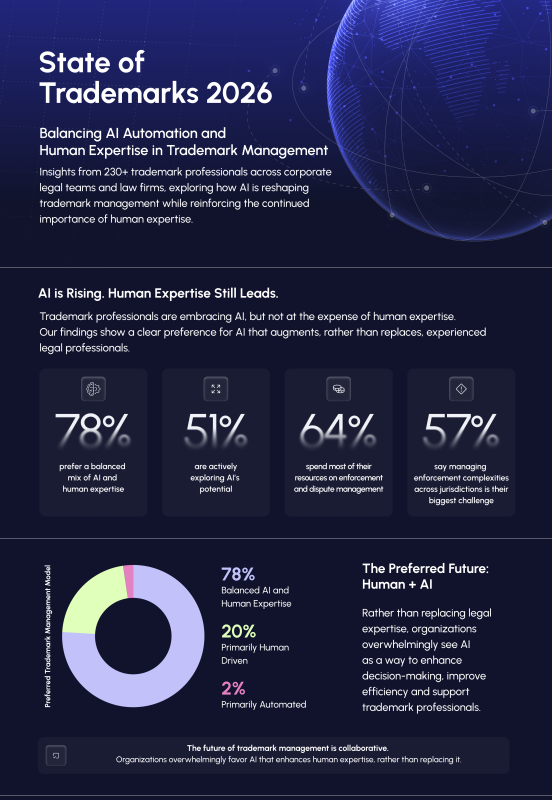
AI and human expertise are the winning combination
To understand how the role of AI is evolving within trademark practice, independent research surveyed 231 leading trademark professionals globally. The study explored current attitudes towards AI adoption, how technology is being applied in day-to-day workflows, and the emerging trends shaping the future of the industry. Some interesting themes were revealed.
The majority of practitioners would like to embrace a hybrid approach to AI use. 78% believe a balanced mix of AI automation with human oversight is the ideal model. Used this way, AI can very effectively streamline trademark workflows, reduce risk, and, crucially, increase the time professionals have available for more complex decision-making. 59% are already adopting this hybrid model, with adoption continuing to accelerate.
Over half of practitioners are now actively investigating AI’s potential through exploration and experimentation, a jump of 10% on last year. This indicates an industry becoming more ready to evolve and adapt. Meanwhile, the proportion not using AI at all has fallen, from 27% in 2025 to 23% today, as more legal teams look to harness its potential.
AI is delivering measurable benefits
As AI technology continues to evolve, it is being embraced by both those looking to protect brands and bad actors seeking to exploit them. While it is streamlining legal processes, it also enables faster creation of infringing content. With the crowded naming landscape remaining the biggest trend across the sector, legal teams are deploying AI strategically to address specific challenges.
Today, AI is used for search and clearance by 28% of professionals, accelerating what has traditionally been a highly laborious process. Other popular applications include drafting correspondence (18%) and workflow support (17%). Looking ahead, monitoring and enforcement is set to be the biggest area of growth, with 37% of respondents planning to adopt AI-driven tools in this area over the next 12 months. This represents the strongest anticipated increase in AI adoption identified in the research.
The need for efficiency is driving AI investment
As the sheer volume of work increases, trademark practitioners are looking to AI as a way to achieve more with existing resources. 52% of practitioners mentioned budget constraints as a key challenge, second only to managing enforcement complexities across jurisdictions (57%). This is encouraging legal teams to turn to AI for improving efficiencies.
Meanwhile, monitoring resources are also becoming increasingly stretched. In 2025, only 23% of practitioners cited this as a concern, compared with nearly a third (32%) today. This rise is driving greater interest in AI-assisted monitoring and enforcement, marking the most significant shift in AI use from trademark clearance and search to enforcement and dispute management. For the first time, almost two-thirds (64%) of practitioners say they spend the majority of their resources on this area, overtaking clearance and search as the primary focus.
Momentum behind investment
Faced with the competing pressures of tight budgets and a crowded naming landscape, trademark practitioners are looking to trademark technology to help ease the burden. 15% say they plan to increase their investment in trademark tools or services over the next 12 months. Notably, this is a jump of 10% on 2025, indicating a growing realization that investment in AI can help trademark teams to maximize stretched resources.
The trend towards greater investment is clear. Those with no plans to boost investment have fallen from 42% in 2025 to 33% today. Law firms are leading the way. The proportion of those who are familiar with AI has jumped from 38% to 58% in a single year, and 18% plan to increase investment in the next 12 months. In-house teams are also gaining momentum, with planned investment more than doubling year-on-year from 5% to 11%.
Collaboration is the future
As bad actors increasingly harness AI to create new threats for brands worldwide, there’s a growing need for trademark practitioners to use AI to combat these threats. The fact that greater numbers of practitioners are already integrating AI into their workflows is encouraging.
Success will depend on integrating AI into existing workflows to support, not replace, human oversight, and that is the model the industry is transitioning to. As more trademark professionals invest in AI and experience the benefits firsthand, confidence in the technology will continue to grow, helping to build resilience and futureproof trademark management.



You may also like…

Winter IP Conference 2026: 5 November, London UK
After two highly successful and well-regarded annual events, we’re thrilled to announce the Winter Intellectual...

Mexico moves toward tougher criminal IP enforcement with new commercial-scale test
Mexican Senate committees have approved, with modifications, a presidential bill that would significantly change the...

Ninth Circuit rejects trademark claim against Google over search results
The US Court of Appeals for the Ninth Circuit has affirmed the dismissal of trademark and related claims brought by...
Contact us to write for out Newsletter